
Published: · Updated:
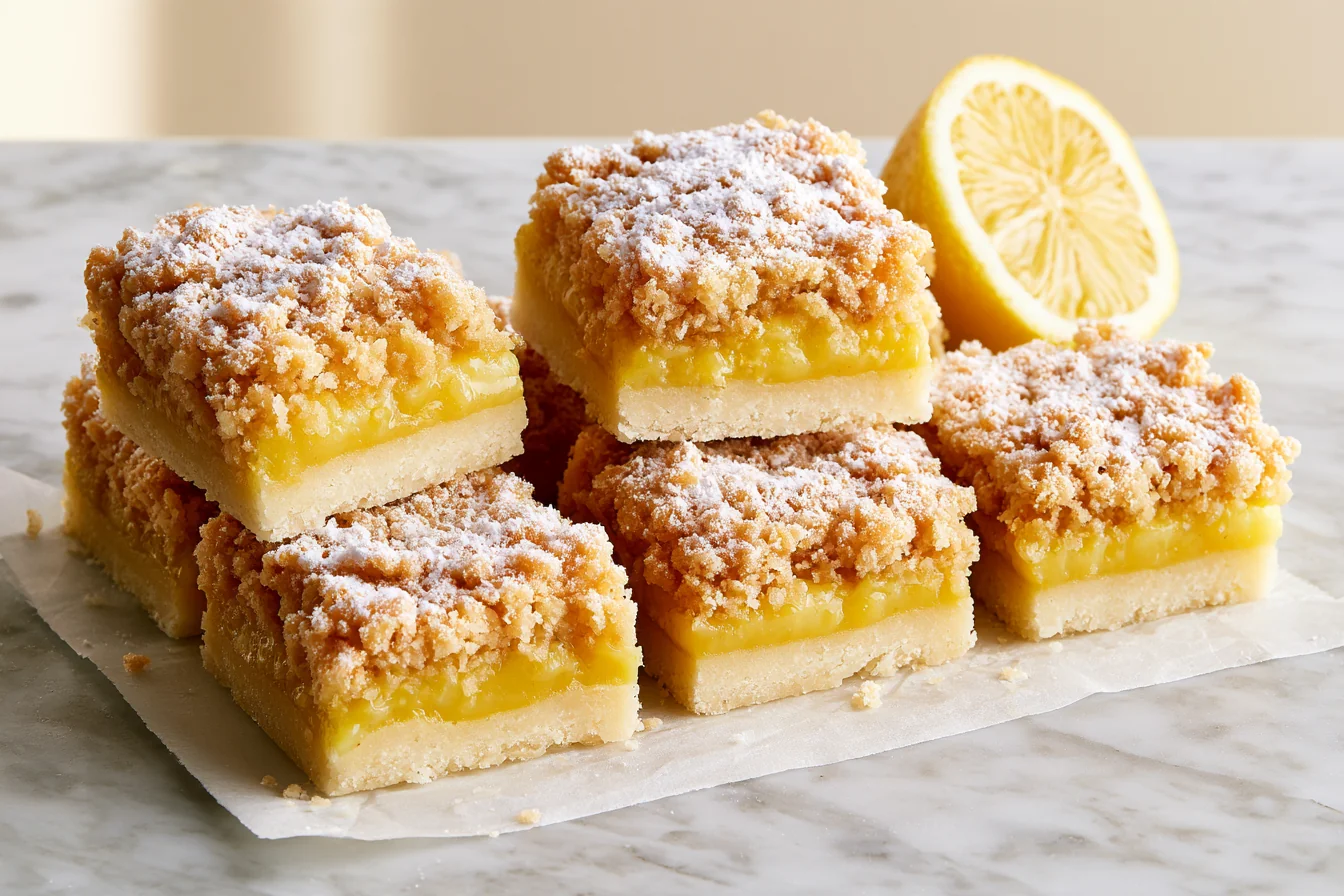
Lemon crumb bars are three layers from two bowls: a buttery crumb mixture that becomes both the pressed base and the loose topping, with a sharp lemon custard baked between them. A 9×9 pan gives sixteen bars, and the oven does the work in three short stages rather than one long one.
One Bowl of Crumbs, Two Jobs
Most crumb bar recipes ask you to make a crust and then make a topping. This one makes a single mixture and splits it. Flour, sugar, salt and cold butter rubbed together give you coarse crumbs; two thirds get pressed into the pan and baked into a base, one third waits in the bowl and goes on top at the end.
That split is the whole trick, and it is why the proportions matter more than they look. Too little butter and the pressed layer never holds together when sliced. Too much and the reserved crumbs melt into a sheet instead of staying separate.
The reserved third gets a spoonful of brown sugar stirred through it before it goes on. That is the only difference between the two layers, and it is what makes the top golden and the base pale.
Ingredients
For the crumbs — base and topping
- 2 cups (240 g) all-purpose flour
- ⅔ cup (135 g) granulated sugar
- ½ teaspoon fine salt
- 1 cup (227 g) cold unsalted butter, diced
- 2 tablespoons light brown sugar, for the reserved crumbs only
For the lemon layer
- 4 large eggs
- 1⅓ cups (270 g) granulated sugar
- ¼ cup (30 g) all-purpose flour
- ⅔ cup (160 ml) fresh lemon juice, from about 4 lemons
- 2 tablespoons lemon zest
| Ingredient | What it does | Swap |
|---|---|---|
| Cold butter, diced | Stays in solid pieces through the rubbing, which is what makes crumbs rather than dough. Softened butter gives you a paste and the topping bakes flat. | None. Temperature is the point here, not the fat. |
| Flour in the lemon layer | Sets the custard so it slices cleanly. Without it the filling stays loose and runs when you cut. | Cornstarch, half the amount. Slightly glossier, slightly softer set. |
| Fresh lemon juice | Bottled juice tastes flat and faintly metallic against this much sugar. Zest carries most of the aroma, juice carries the acidity. | Meyer lemon for something rounder and less sharp; you may want a tablespoon less sugar. |
The filling is an egg custard, which is also why it needs its full time in the oven: University of Wisconsin-Madison Extension advises cooking egg mixtures until the centre reaches 160°F. A set, no-longer-liquid centre is what that looks like without a thermometer.
Zest the lemons before you juice them — it is close to impossible afterwards. Rub the zest into the sugar with your fingertips before adding anything else and the oils spread through the whole filling instead of sitting in specks. The same technique improves plain lemon bars and blueberry lemon pie bars.
Step by Step
1. Line the pan and heat the oven
Set the oven to 350°F (175°C). Line a 9×9-inch pan with parchment, leaving an overhang on two sides so you can lift the slab out later.
The overhang matters more than it sounds. Cutting these in the pan drags the topping off.
2. Rub the crumbs
Whisk the flour, granulated sugar and salt. Scatter in the cold diced butter and work it in with a pastry cutter or your fingertips until no butter pieces are visible.
Stop when the mixture looks like coarse damp sand and holds its shape if you squeeze a handful. Keep going past that and it turns into dough.
3. Split the mixture
Scoop out a generous cup of crumbs into a separate bowl and stir the brown sugar through it. Set it aside. Press everything that remains firmly and evenly into the lined pan.
Press hard, especially into the corners. A loose base crumbles under the custard.
4. Bake the base
Bake for 18 minutes, until the surface looks dry and the edges are just beginning to colour. Leave it in the pan and let it sit five minutes.
It should not be golden yet — it has two more bakes to go.
5. Mix and pour the lemon layer
Rub the zest into the sugar, whisk in the flour, then the lemon juice and eggs, until completely smooth. Pour it over the warm base.
Pouring onto a warm base helps the custard start setting at the join instead of soaking in. Whisk again right before pouring if it has been sitting.
6. Bake the filling
Bake for 15 minutes, until the filling has lost its liquid sheen and barely moves at the edges.
Tilt the pan an inch: the surface should move as a single sheet, not as a wave.
7. Scatter the crumbs
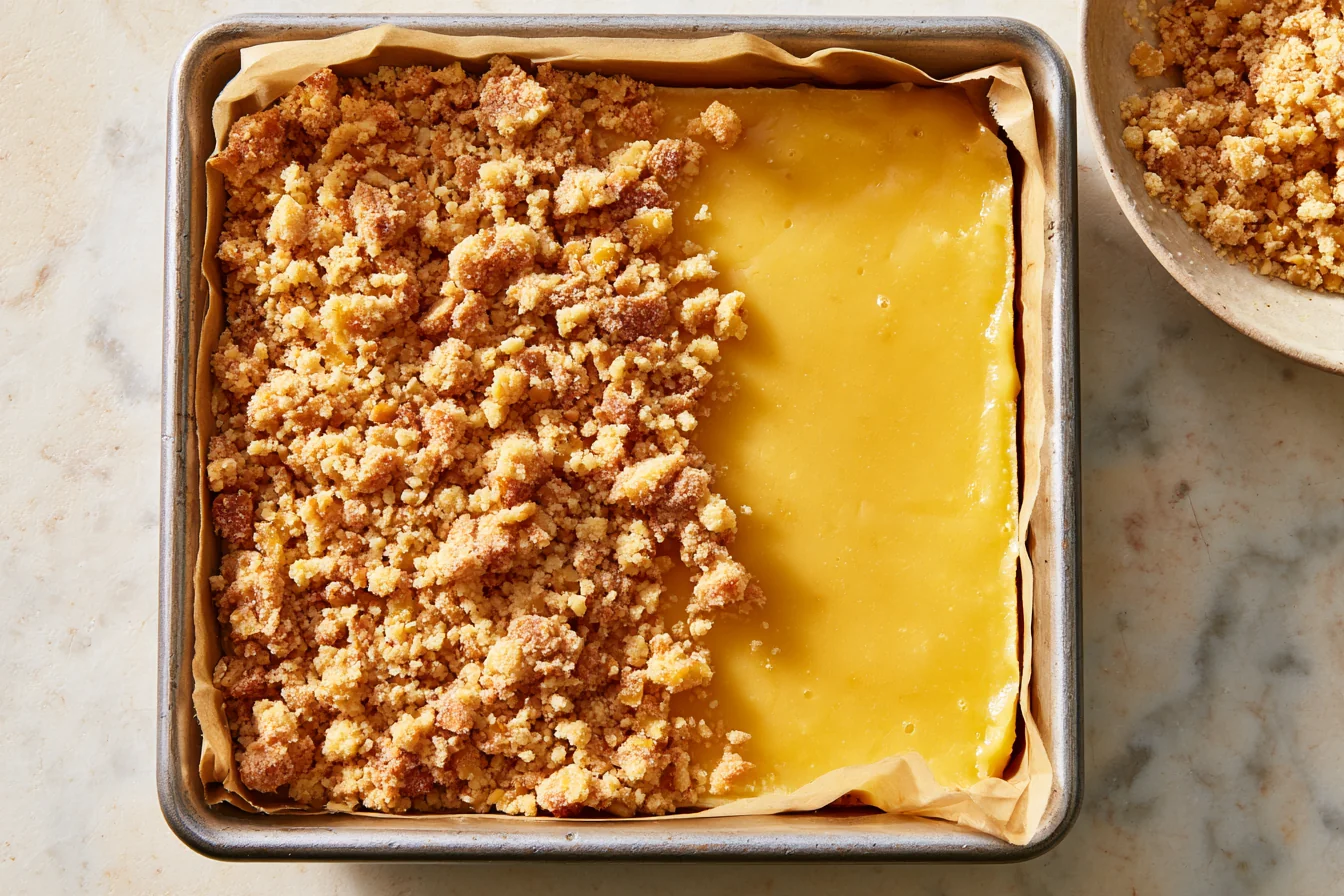
Sprinkle the reserved crumbs evenly over the surface.
Scatter, do not press. The crumbs should sit on the surface, not sink.
8. Finish the bake
Return it to the oven for 20 to 22 minutes, until the topping is pale gold and the centre no longer wobbles as a liquid.
A slight jiggle like set jelly is right. A ripple that travels across the pan is not.
9. Cool, then cut
Cool in the pan for at least two hours, then lift the slab out by the parchment and cut it into sixteen squares, wiping the knife between cuts.
An extra hour in the refrigerator before cutting is what gives sharp edges rather than soft ones.
Knowing When Each Layer Is Done
Three bakes means three judgements, and the common mistake is applying the last one to all of them.
The base is ready when it looks matte rather than wet and smells faintly of butter. Colour is not the test; it should still be pale.
The filling after its second bake should have a skin that no longer shines like liquid. Tilt the pan an inch: the surface moves as a single sheet, not as a wave.
The finished slab is done when the topping has taken colour at the raised edges and the centre, tilted again, shivers rather than sloshes. It firms considerably as it cools, so pulling it out slightly early is safer than leaving it in.
What Makes the Difference
- Weigh the flour, or spoon it in. Scooped flour packs, and the crumbs turn dry and sandy instead of clumping.
- Work fast with the butter. Warm hands melt it. If the mixture starts looking greasy, put the bowl in the fridge for ten minutes.
- Strain the juice. Pips and pulp end up as odd chewy threads in a set custard.
- Cool completely before cutting. Two hours at room temperature minimum, and an hour in the fridge after that if you want sharp edges.
- Wipe the knife between cuts. One pass, one wipe. It is the difference between sixteen clean squares and sixteen smeared ones.
Other Citrus, Other Toppings
- Lime. Same quantities, noticeably sharper. Works well with a pinch of salt on top of the baked bars.
- Oats in the topping. Swap a quarter cup of the reserved crumbs for rolled oats, as in these raspberry oatmeal crumble bars.
- Berry swirl. Dot a few tablespoons of thick raspberry jam over the filling before the second bake.
- Almond. Half a teaspoon of almond extract in the filling, and flaked almonds over the crumbs.
- Stone fruit instead. The same crumb method carries peach crumble bars, with fruit in place of the custard.
Keeping and Cutting
Lift the whole slab out by the parchment before cutting, and trim a thin strip off each edge if you want every square to look the same. Cut four by four for sixteen bars, or three by three for nine generous ones.
They keep in the refrigerator, airtight, for about five days, and the texture is arguably better on day two once the base has firmed. At room temperature give them a day at most — this is an egg custard, and it softens. They freeze for up to three months, cut and layered between parchment; thaw them in the refrigerator rather than on the counter so no condensation lands on the topping.
A dusting of powdered sugar is best done just before serving. Put it on early and the custard simply absorbs it.
FAQ
Why is my lemon layer runny?
Underbaked, or short on flour. The filling needs its full second and third bake, and it sets further as it cools — judge it the next day before deciding it failed. If it is genuinely liquid, the quarter cup of flour was probably mismeasured.
Can I use bottled lemon juice?
You can, but it is the one substitution that shows. Against 1⅓ cups of sugar, bottled juice reads as flat and slightly metallic. If it is all you have, add the zest of two fresh lemons to compensate.
Why did my topping disappear into the filling?
It went on too early, while the custard was still liquid. The filling needs its own fifteen minutes to set a skin first, and the crumbs should be scattered rather than pressed.
Can I make these in a 9×13 pan?
Multiply everything by one and a half. The layers end up about the same depth, the base needs roughly the same 18 minutes, and the final bake runs a few minutes shorter because the slab is thinner at the edges.
Lemon Crumb Bars
Ingredients
Equipment
Method
- Heat the oven to 350F (175C). Line a 9x9-inch pan with parchment, leaving an overhang on two sides.
- Whisk the flour, granulated sugar and salt. Scatter in the cold diced butter and work it in with a pastry cutter or your fingertips until no butter pieces remain and the mixture looks like coarse damp sand.
- Scoop a generous cup of crumbs into a separate bowl and stir the brown sugar through it. Set aside. Press the rest firmly and evenly into the lined pan, especially into the corners.
- Bake for 18 minutes, until the surface looks dry and the edges are just beginning to colour. It should still be pale. Let it sit 5 minutes.
- Rub the zest into the sugar with your fingertips, whisk in the flour, then the lemon juice and eggs, until completely smooth. Pour over the warm base.
- Bake for 15 minutes, until the filling has lost its liquid sheen and moves as a single sheet when the pan is tilted.
- Scatter the reserved crumbs evenly over the surface without pressing them in.
- Bake for a further 20 to 22 minutes, until the topping is pale gold and the centre shivers rather than sloshes.
- Cool in the pan for at least 2 hours, then lift out by the parchment and cut into 16 squares, wiping the knife between cuts.
Leave a Reply