
Published: · Updated:
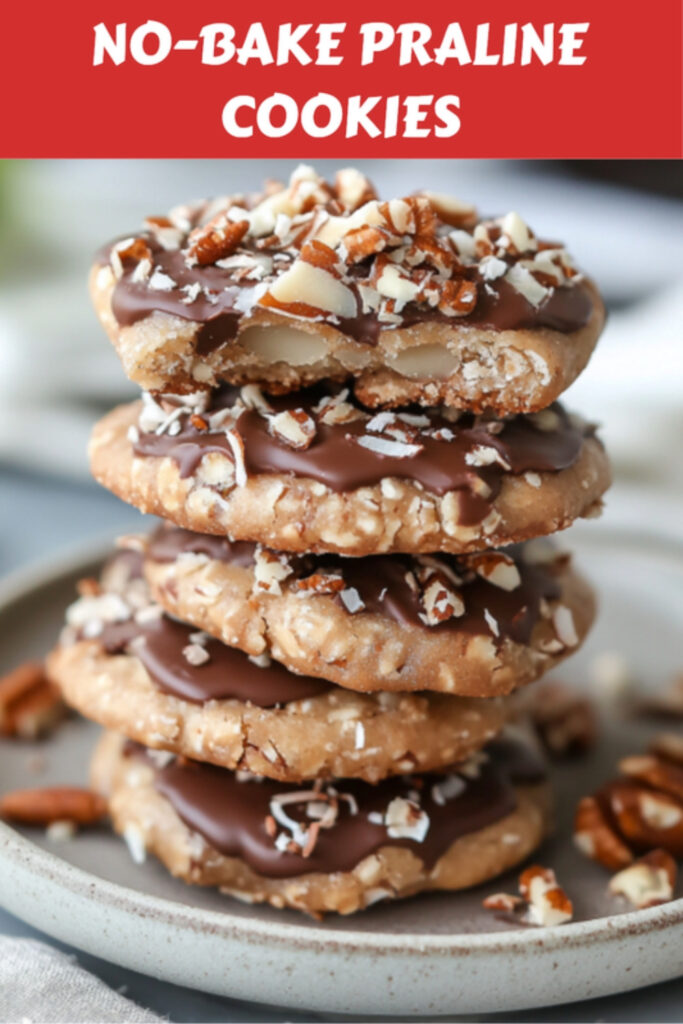
Ninety seconds at a full boil decides everything here. Get that right and the sugar, butter and evaporated milk turn into a soft praline syrup that binds quick oats, shredded coconut and chopped pecans into chewy no bake coconut praline cookies, finished with a spoonful of melted chocolate on top; fifteen minutes of work, about an hour of setting, and roughly twenty cookies.

The Ninety-Second Rule
Every no-bake cookie built on a boiled sugar base lives or dies by one number: how long the pot stays at a true boil after it gets there. Pull it too early and the syrup never reaches the concentration that firms up as it cools, so the cookies stay sticky and slump on the tray. Leave it too long and the syrup crosses into candy territory; the cookies set hard, then turn dry and crumbly within a day.
Recipe writers who have tested this land between 60 and 90 seconds of boiling for a mixture like this one. This version uses 90, because evaporated milk and brown sugar hold a little more moisture than plain milk and white sugar, and the pecans and coconut add less absorbency than a full three cups of oats would. If you own a thermometer, the syrup should read 230 to 234°F (110 to 112°C) when you take it off, a few degrees under the soft-ball stage that Colorado State University Extension puts at 234 to 240°F at sea level. Above 3,000 feet, the same page says to lower candy temperatures by 2°F for every 1,000 feet of elevation, so time the boil rather than trusting the thermometer.
The chocolate on top is not decoration. The base is sweet and soft; a thin cap of semisweet chocolate adds bitterness and a snap, the way the shell does on no-bake Butterfinger balls. Chopped pecans and a pinch of coconut pressed into the wet chocolate give the tops the look in the photo.
Pantry, Fridge and One Bag of Pecans
For the cookie base
- 1 cup (200 g) granulated sugar
- ¾ cup (150 g) packed light brown sugar
- ½ cup (113 g) unsalted butter, cut into pieces
- ½ cup (120 ml) evaporated milk — not sweetened condensed milk
- ¼ teaspoon fine salt
- 1 teaspoon vanilla extract
- 2 cups (180 g) quick oats
- 1½ cups (120 g) sweetened shredded coconut
- 1 cup (115 g) chopped pecans
For the top
- 1 cup (170 g) semisweet chocolate chips
- 1 teaspoon refined coconut oil
- ¼ cup (30 g) chopped pecans
- 2 tablespoons sweetened shredded coconut
| Ingredient | What it does | Swap |
|---|---|---|
| Evaporated milk | Gives the syrup body and a faint caramel note without the extra sugar of condensed milk. Its lower water content is part of why 90 seconds is enough. | Whole milk works, but boil the full 90 seconds and expect a slightly softer cookie. Do not use skim. |
| Quick oats | Thin flakes soak up the hot syrup in the few minutes it takes to scoop, so the cookies hold a round shape. | Old-fashioned oats, pulsed five or six times in a food processor. Whole rolled oats stay chewy and loose. |
| Chopped pecans | The praline part. Their fat and crunch keep the cookie from reading as plain oatmeal. | Walnuts or toasted almonds, same weight. |
Toasting the pecans is optional but worth five minutes: spread them on a dry skillet over medium heat and shake the pan until they smell nutty, then cool before chopping. Buy a bigger bag than you need; the same nuts go into sea salted praline pecan clusters, a microwave candy where a brown sugar, butter and corn syrup coating is poured over pecan halves.
From Saucepan to Tray
1. Line the tray and measure everything
Line a baking sheet with parchment. Measure the oats, coconut and pecans into one bowl, and have the vanilla and salt beside the stove. Once the syrup comes off the heat you have about three minutes before it starts to firm, so nothing gets measured after that point.
2. Melt the sugars into the milk and butter
Put both sugars, the butter and the evaporated milk in a medium saucepan over medium heat. Stir until the butter melts and the grains of sugar disappear from the back of the spoon; the mixture goes from sandy and pale to glossy and tan. Stop stirring once it starts to bubble at the edges.
3. Boil for 90 seconds, timed
Wait for the whole surface to bubble, not just the rim, then start a timer for 90 seconds and let it boil without stirring. The bubbles get larger and slower as the water cooks off, and the syrup darkens half a shade toward caramel. Take the pan off the heat the moment the timer sounds.
4. Stir in the dry ingredients
Add the salt and vanilla (it will spit), then the oats, coconut and pecans all at once. Stir fast with a sturdy spoon until no dry oats remain and the mixture pulls away from the sides of the pan in a thick mass, about 30 seconds.
5. Scoop while it is still warm
Drop level 2-tablespoon scoops onto the parchment, 20 or so, spaced an inch apart. Press each gently with damp fingers to flatten the top. Scoop steadily: a mixture that has cooled in the pan crumbles instead of holding together.
6. Let them set, then top with chocolate
Leave the tray at room temperature for 30 minutes, or in the fridge for 15. Melt the chocolate chips with the coconut oil in 20-second bursts in the microwave, stirring between bursts, until smooth. Spoon a teaspoon over each cookie and spread it to the edges, then scatter the extra pecans and coconut over the wet chocolate. Fifteen more minutes in the fridge firms the chocolate.

Reading the Boil, Then the Tray
Two checkpoints tell you whether the batch will set. The first is in the pan: at the end of the 90 seconds, the syrup coats the spoon in a thin layer that does not immediately run off, and a thermometer, if you use one, sits between 230 and 234°F. The second is on the tray: after 30 minutes at room temperature, a cookie lifts off the parchment in one piece and dents only slightly under a fingertip. Still shiny and tacky after 45 minutes means the boil was short; the fridge will firm them enough to eat, though they stay soft. A matte, cracked surface after ten minutes means the boil ran long, and the chocolate on top is what will keep them pleasant.
| Boil time at a full boil | What you get |
|---|---|
| Under 60 seconds | Syrup too thin; cookies stay sticky and spread, and need the fridge to hold together. |
| 60 to 90 seconds | Chewy, holds its shape at room temperature, soft bite. The target. |
| Over 2 minutes | Sets hard and crumbles by the next day; tastes closer to candy than cookie. |
Why a Batch Fails
- Timing from the first bubble instead of the full boil. The edges bubble a good minute before the center does; start the clock only when the whole surface is moving.
- Using sweetened condensed milk. It is thicker and far sweeter than evaporated milk, and the ratio of sugar to liquid no longer works.
- Scooping slowly. Measure the dry ingredients first, stir fast, and have the scoop in hand before the pan comes off the heat.
- Skipping the salt. A quarter teaspoon does not make the cookies salty; without it the praline flavor reads flat and one-dimensional.
- Topping with chocolate before the base has set. Warm cookies melt the chocolate into the oats instead of holding a cap on top.
Swaps That Still Set
- Dark chocolate tops: use 70% chocolate, chopped, instead of semisweet chips for a sharper contrast with the sweet base.
- Salted praline: swap the salt for ½ teaspoon flaky sea salt stirred in with the vanilla, and skip the coconut on top.
- Toasted coconut: toast the shredded coconut in a dry skillet until golden before stirring it in; the cookies taste nuttier and a little less sweet.
- Without pecans: replace them with another ½ cup of oats and ½ cup of coconut. You lose the praline character but the cookies still set; for a nut-free praline flavor, a stovetop confection like pumpkin fudge made on the stove is a better fit.
- Bars instead of cookies: press the warm mixture into a parchment-lined 8-inch square pan, spread the chocolate over the whole slab, chill, and cut into 16 squares.
Fridge Beats Counter
These keep best in the refrigerator in an airtight container with parchment between the layers: the chocolate stays firm and the base keeps its chew. At a cool room temperature they hold for a few days but soften, and the chocolate dulls. For longer storage, freeze them in a single layer on a tray first, then transfer to a freezer bag; university extension storage charts give home-baked cookies 8 to 12 months at 0°F for best quality, and these no-bake ones freeze just as well. Thaw in the fridge so condensation does not bead on the chocolate.
If you like this style of stovetop sweet, the same boiled-sugar logic runs through pralines and cream fudge, where the syrup is cooked longer and poured into a pan, and through the praline glaze on southern pecan praline sheet cake, which is poured over the baked cake.
FAQ
Why didn’t my no bake cookies set?
Almost always a short boil. The syrup has to reach a full boil across the whole surface and stay there for 90 seconds; starting the timer when the edges first bubble cuts that time roughly in half. Humid weather and skim or low-fat milk make it worse. A batch that will not set still works chilled, or pressed into a pan and cut into bars after a night in the fridge.
Can I use old-fashioned oats instead of quick oats?
Yes, if you pulse them five or six times in a food processor to break the flakes down. Used whole, they absorb the syrup slowly, the cookies stay loose and chewy in the wrong way, and more of them fall apart when you pick them up.
Can I leave off the chocolate?
You can; the base is a complete cookie on its own and sets the same way. Without the chocolate the cookies are noticeably sweeter, so consider the salted variation above, and store them in the fridge, where the praline base stays firmest.
Do I need a candy thermometer?
No. The 90-second timer is the method, and it is what most no-bake cookie recipes rely on. A thermometer is a useful check, especially at altitude where water boils cooler and the syrup needs longer; aim for 230 to 234°F before you pull the pan.
No Bake Coconut Praline Cookies
Ingredients
Equipment
Method
- Line a baking sheet with parchment. Measure the oats, coconut and pecans into one bowl and set the vanilla and salt beside the stove.
- Combine both sugars, the butter and the evaporated milk in a medium saucepan over medium heat. Stir until the butter melts and the sugar dissolves, then stop stirring once it bubbles at the edges.
- When the whole surface is boiling, start a timer for 90 seconds and boil without stirring. Remove from the heat as soon as the timer sounds (230 to 234°F on a thermometer).
- Stir in the salt and vanilla, then the oats, coconut and pecans. Stir quickly until no dry oats remain and the mixture pulls away from the sides of the pan, about 30 seconds.
- Drop level 2-tablespoon scoops onto the parchment, about 20, an inch apart. Press each gently with damp fingers to flatten the top. Work steadily while the mixture is warm.
- Let the cookies set at room temperature for 30 minutes, or in the refrigerator for 15. Melt the chocolate chips with the coconut oil in 20-second microwave bursts, stirring between bursts, until smooth.
- Spoon about a teaspoon of chocolate over each cookie and spread it to the edges. Scatter the extra pecans and coconut over the wet chocolate, then refrigerate 15 minutes to firm the tops.
Leave a Reply