
Published: · Updated:
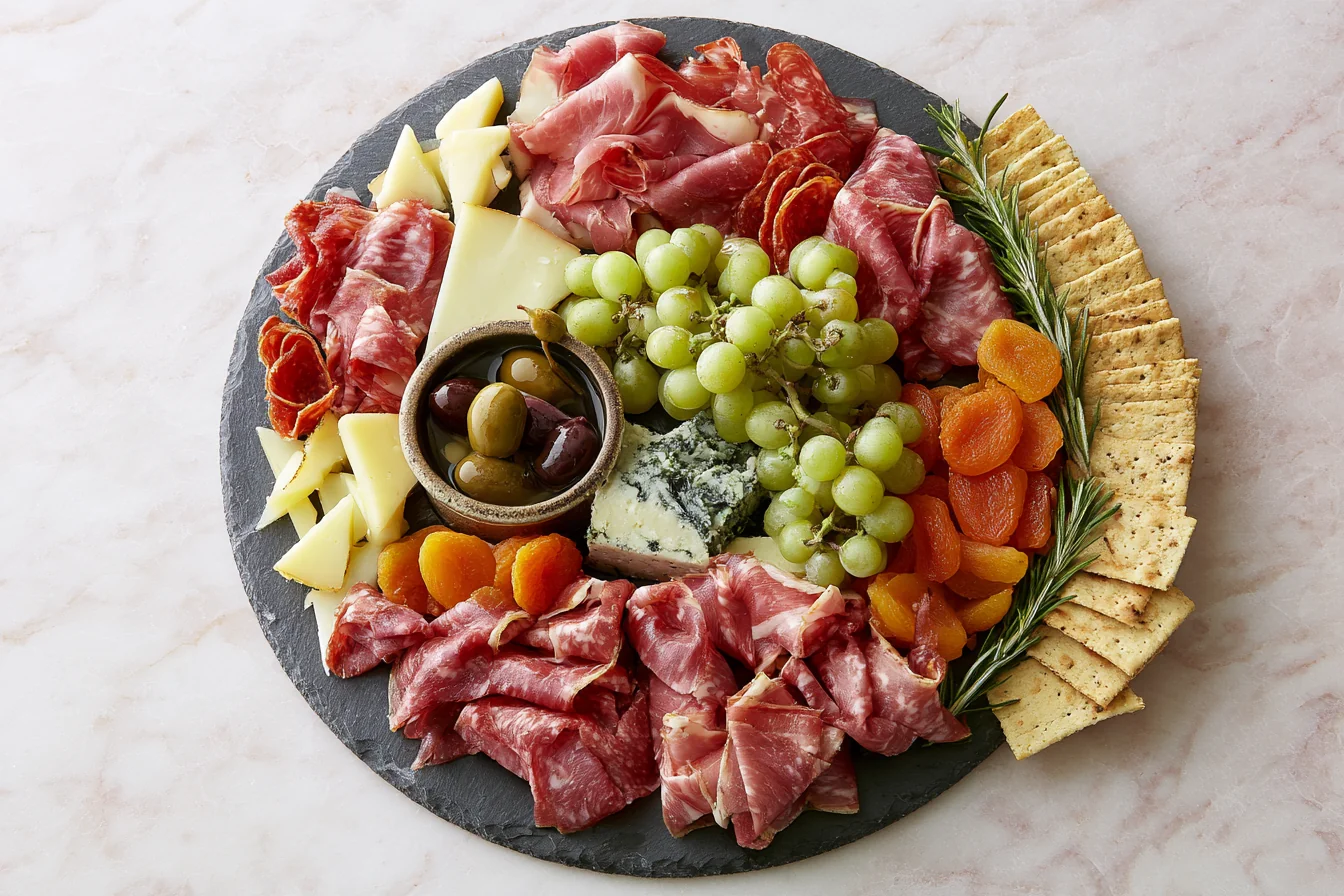
A charcuterie board is a shopping problem before it is a cooking one. Nothing gets cooked; the work is buying the right amounts and putting them down in the right order. Twenty minutes of assembly feeds eight people from about 28 ounces of cured meat and 21 of cheese.
How Much to Buy per Person
This is the question that actually decides whether the board works, and most recipes skip it. The answer depends on one thing: whether the board is the meal or the opening act.
| The board is… | Meat per person | Cheese per person |
|---|---|---|
| Something to pick at before dinner | 1 to 2 oz | 1 to 2 oz |
| The main event | About 4 oz | About 4 oz |
| This board, for eight | 3.5 oz (28 oz total) | 2.6 oz (21 oz total) |
Buy more crackers and bread than you think you need. They are what people reach for when the meat runs low, they cost almost nothing, and a board with bare patches and no carbs to refill it looks finished long before anyone has stopped eating.
What Goes on It
Cured meats — about 28 oz
- 8 oz prosciutto or serrano ham
- 8 oz capicola or bresaola
- 8 oz soppressata or Genoa salami
- 4 oz pâté, if you want something to spread
Cheeses — about 21 oz, in four textures
- 5 oz soft: a log of chèvre or a small brie
- 8 oz semi-firm: Gouda or Fontina
- 4 oz blue: Roquefort or Gorgonzola
- 4 oz hard: aged cheddar, Manchego or Parmesan
Everything else
- Sweet: grapes, a sliced apple or pear, dried apricots, cherries
- Sharp: olives, cornichons, pickled onions
- Spreadable: fig jam, honey, wholegrain mustard
- Crunchy: Marcona almonds, walnuts
- Carbs: a sliced baguette, flatbread crackers, breadsticks
- Green: a few sprigs of rosemary or thyme, for gaps
| Choice | Why it matters | Swap |
|---|---|---|
| Four cheese textures | Variety of texture reads as abundance far more than variety of flavour does. Three soft cheeses look like one cheese. | Three is enough on a smaller board: soft, firm, blue. |
| Something sharp | Cured meat and cheese are both salty and fatty. Pickles and vinegar are what let people keep eating. | A small bowl of pickled red onion does the same job and looks better. |
| Whole wedges, not pre-sliced | A wedge with a knife beside it stays fresh through the evening. Pre-sliced cheese dries at the edges within an hour. | Slice the firm cheeses only, and leave the soft ones whole. |
Toss apple or pear slices in lemon juice before they go on, or they brown while you are still arranging everything else. If you are building a bigger spread, this board sits well beside an easy fruit platter or a tray of stuffed mushrooms.
Step by Step
1. Pick the board and the bowls
Choose something larger than feels necessary, and set out two or three small bowls for anything wet — olives, jam, mustard.
The bowls go down before the food. Trying to wedge one in at the end means moving everything.
2. Place the cheeses first, wide apart
Put each cheese in a different quadrant, leaving real space between them. Do not centre them.
At this stage the board should look almost empty. That is correct — the cheeses are anchors, not the display.
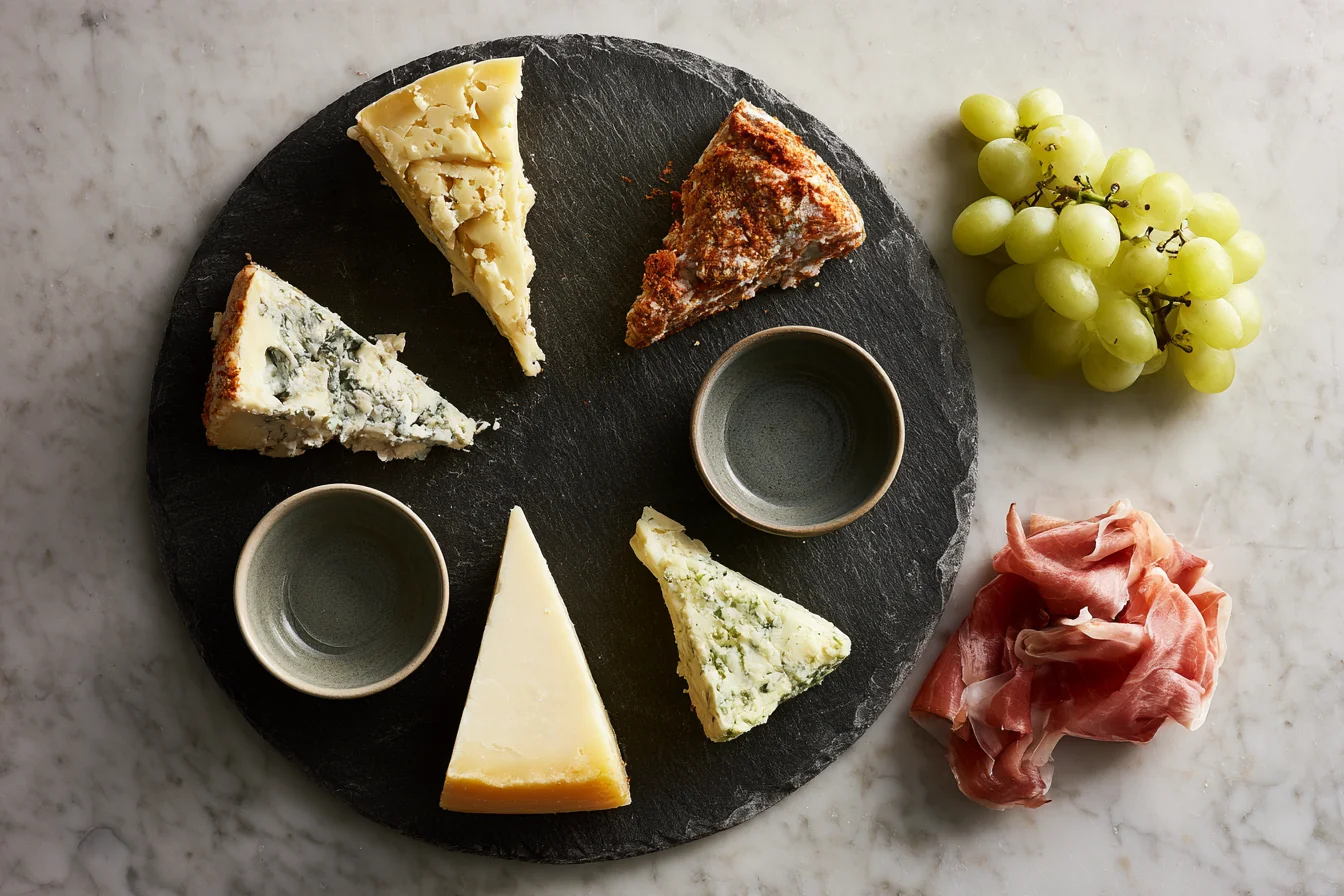
3. Add the meats beside each cheese
Fold or ribbon the slices rather than laying them flat; folded meat has height and catches the light. Put a pairing beside each cheese: prosciutto near the soft cheese, salami near the hard one.
Each pile should look loose and airy, not stacked like a deck of cards.
4. Fill the large gaps
Drop in the bowls of olives, jam and mustard, then the clusters of grapes and the larger fruit.
Work from biggest to smallest. Large items placed last never fit.
5. Close the small gaps
Tuck nuts, dried fruit and crackers into whatever bare patches remain, overlapping onto the meats and cheeses where you need to.
No slate or wood should be visible except as a deliberate border. Step back and look from a metre away — sparse areas show up from there and not from above.
6. Garnish and arm it
Tuck in herb sprigs, then add a knife for each cheese, a spoon for each bowl, and small tongs for the meat.
One knife for four cheeses means blue cheese in the chèvre within five minutes.
The Clock You Need to Watch
This is the one genuine risk on a board, and it has nothing to do with how it looks.
Cured meat, soft cheese and pâté are perishable. UF/IFAS Extension puts it plainly: discard perishable food left at room temperature for longer than two hours, and after one hour if it is above 90°F. Bacteria multiply quickly between 40°F and 140°F, which is precisely where a board sits all evening.
In practice: put out half of everything and keep the rest in the refrigerator. Refill at the ninety-minute mark with cold replacements, and take the first batch away rather than topping it up. A board that has sat out for three hours should be thrown away, however untouched it looks — hard aged cheese is the only thing on it that is genuinely robust.
What Separates a Good Board From a Crowded One
- Odd numbers. Three or five of each category reads as deliberate; four reads as a grid.
- Height. Folded meat, a small raised bowl, a wedge standing on its edge. A flat board looks like a plate.
- Colour in the gaps. Grapes, apricots and herbs are doing visual work, not culinary work.
- Labels for the blue. A small card beside anything strong saves the guest who hates blue cheese from finding out the hard way.
- Assemble cold, serve at room temperature. Build it, cover it, refrigerate it, then take it out 30 to 45 minutes before serving — cold cheese tastes of very little. That 45 minutes counts towards your two hours.
Variations
- Italian. Prosciutto, soppressata, mortadella; Parmesan, Pecorino, burrata; olives and roasted peppers.
- Dessert board. Soft cheeses only, with honeycomb, chocolate, figs and berries.
- Breakfast board. Smoked salmon in place of the cured meat, cream cheese, capers, cucumber and bagel halves.
- Small and cheap. Two cheeses, one meat, one pickle, one jam. The method does not change.
- Warm anchor. One hot item in the middle changes the whole table — baked brie set in a small dish, replaced when it cools.
- Individual cups. Portion everything into small glasses instead of one board, which solves the two-hour problem by keeping the rest chilled.
Prep Ahead and Leftovers
You can assemble the whole board up to a day in advance, cover it tightly with plastic wrap and refrigerate it, leaving the crackers and bread off until serving. Nuts and anything crisp go on at the last minute too.
If you would rather portion than arrange, the same contents work as individual mezze cups, which also keeps most of the food cold.
Leftovers keep in the refrigerator for up to four days — but only what stayed within the two-hour window. Repackage meats and cheeses separately rather than leaving them pressed together, and use them up in sandwiches or on a fruit and cheese board rather than rebuilding the same display.
FAQ
How much charcuterie do I need for 20 people?
Scale the per-person figures rather than the board: 20 to 40 oz of meat and the same of cheese as an appetiser, roughly 5 lb of each if it is dinner. Build two medium boards instead of one enormous one — they refill more easily and keep less food out at once.
Can I make a charcuterie board the night before?
Yes. Assemble everything except crackers, bread and nuts, wrap it tightly and refrigerate. Add the dry items and take it out 30 to 45 minutes before guests arrive.
What is the difference between a charcuterie board and a cheese board?
Charcuterie means cured meat, so a true charcuterie board leads with meat and uses cheese as support. In common use the word now covers both, and most boards sold as charcuterie are really meat and cheese boards.
How long can a charcuterie board sit out?
Two hours, or one if the room is above 90°F. That is a food safety limit rather than a quality one, and it counts from the moment the board leaves the refrigerator — including the time it spends coming up to room temperature.
Charcuterie Board
Ingredients
Equipment
Method
- Choose a board larger than feels necessary and set out two or three small bowls for anything wet, before any food goes down.
- Place each cheese in a different quadrant, wide apart. The board should still look almost empty at this stage.
- Add the meats beside each cheese, folding or ribboning the slices rather than laying them flat so they have height.
- Fill the large gaps: the bowls of olives, jam and mustard, then clusters of grapes and the larger fruit. Work from biggest to smallest.
- Close the small gaps with nuts, dried fruit and crackers, overlapping onto the meats and cheeses. Step back a metre and look for sparse areas.
- Tuck in herb sprigs, then add a knife for each cheese, a spoon for each bowl and tongs for the meat.
Leave a Reply