
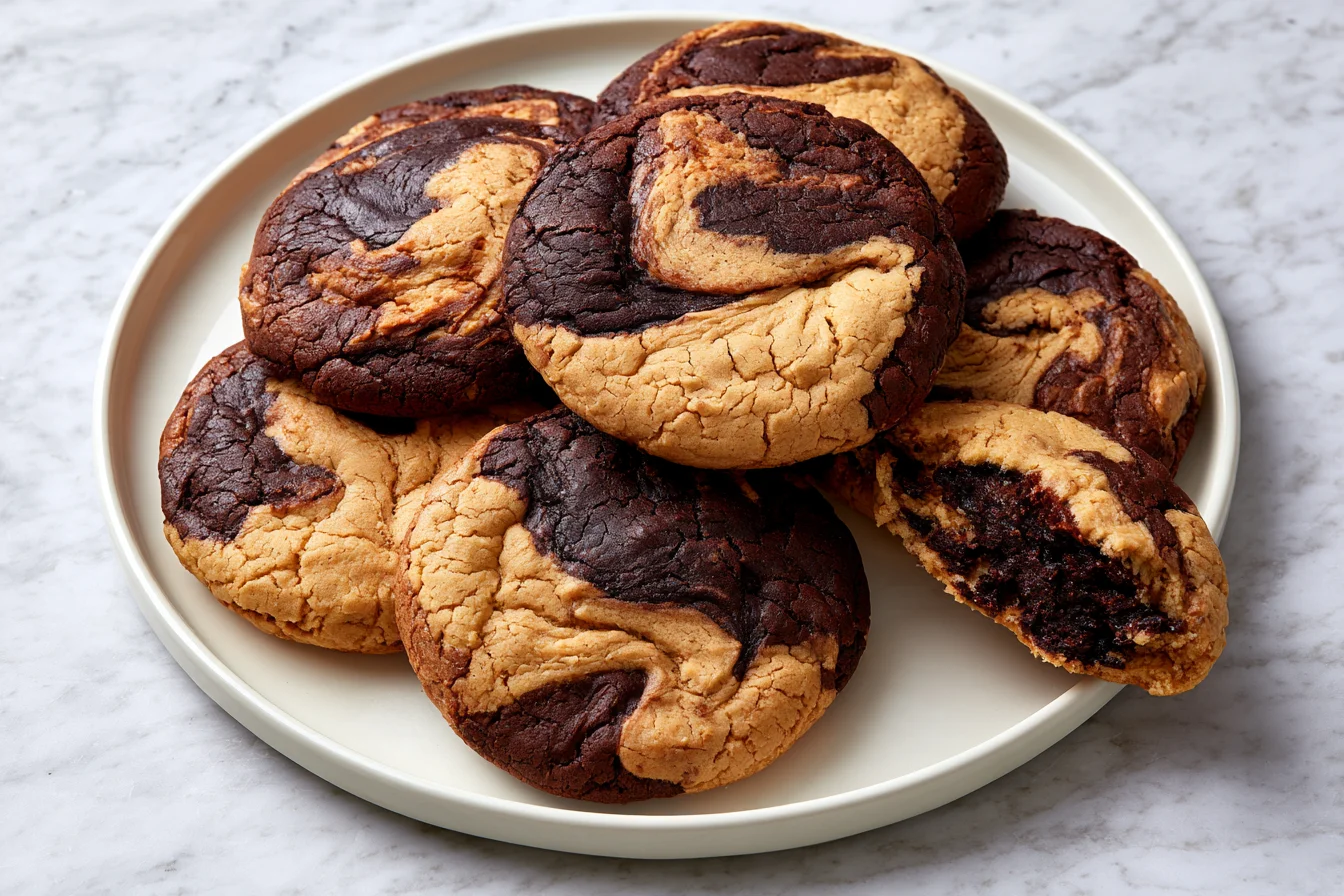
These are two separate cookie doughs, pressed together just enough to marble and no further. You make a peanut butter dough, you make a brownie dough, and the only technique that matters is how little you combine them. About 24 cookies, 350°F, ten to twelve minutes.
The Swirl Is Mechanical, Not Artistic
People think the marbling comes from a clever folding motion. It does not. It comes from stopping early.
Two doughs of similar stiffness, pressed into one ball and rolled once, will hold distinct bands through the whole bake. The same two doughs worked for five seconds longer go muddy brown, and no amount of baking brings the contrast back. There is no technique to learn here, only a point at which to stop.
Which means the real variable is stiffness. If the brownie dough is noticeably softer than the peanut butter dough, it smears instead of sitting beside it, and you get a brown cookie with pale streaks rather than a swirl. Let the melted chocolate cool properly before it goes in, and both doughs will behave the same way in your hands.
Why the Two Doughs Use Different Leaveners
It looks like an inconsistency in the ingredient list. It is not.
Baking soda needs an acid to react with, and it has one in the peanut butter dough: brown sugar. The brownie dough has no brown sugar, so it uses baking powder instead, which already contains its own acid in the form of cream of tartar and works without help.
The two are not interchangeable spoon for spoon either. Baking soda is roughly three times as strong, so swapping powder in at the same quantity leaves a dough that barely lifts. Going the other way, soda in place of powder, overshoots badly and leaves a soapy taste.
There is a visible consequence in this recipe. Soda is the leavener more responsible for outward spread, so the peanut butter half of each cookie moves a little more as it bakes, while the brownie half holds its shape. That small difference is part of what keeps the two colours as bands instead of letting one swallow the other.
Ingredients
Peanut butter dough
- ½ cup unsalted butter, softened
- ½ cup creamy peanut butter
- ½ cup granulated sugar
- ½ cup light brown sugar, packed
- 1 large egg
- 1 tsp vanilla extract
- 1½ cups all-purpose flour
- ½ tsp baking soda
- ¼ tsp salt
Brownie dough
- ½ cup unsalted butter
- 1 cup semi-sweet chocolate chips
- ¾ cup granulated sugar
- 2 large eggs
- 1 tsp vanilla extract
- 1 cup all-purpose flour
- ¼ cup unsweetened cocoa powder
- ½ tsp baking powder
- ¼ tsp salt
Use a commercial creamy peanut butter rather than a natural one that separates. The oil in natural peanut butter is not emulsified, and it leaks into the dough as it sits, leaving the peanut butter half greasy and flat. Commercial peanut butter is the exception to the usual rule that the simpler ingredient is better.
Step by Step
1. Peanut butter dough
Cream the butter, peanut butter and both sugars until light. Beat in the egg and vanilla, then fold in the flour, baking soda and salt until just combined.
It should feel like firm play dough and hold a thumbprint without sticking.
2. Melt the chocolate and let it cool
Melt the butter and chocolate chips together in 30-second bursts in the microwave, stirring between each. Set it aside until it is no warmer than your hand.
Warm chocolate makes a slack dough. This cooling step is the one most people skip and the one that ruins the swirl.
3. Brownie dough
Whisk the sugar, eggs and vanilla, stir in the cooled chocolate, then fold in the flour, cocoa, baking powder and salt.
Aim for the same stiffness as the first dough. If it is looser, give it ten minutes in the refrigerator before you go on.
4. Pair and press
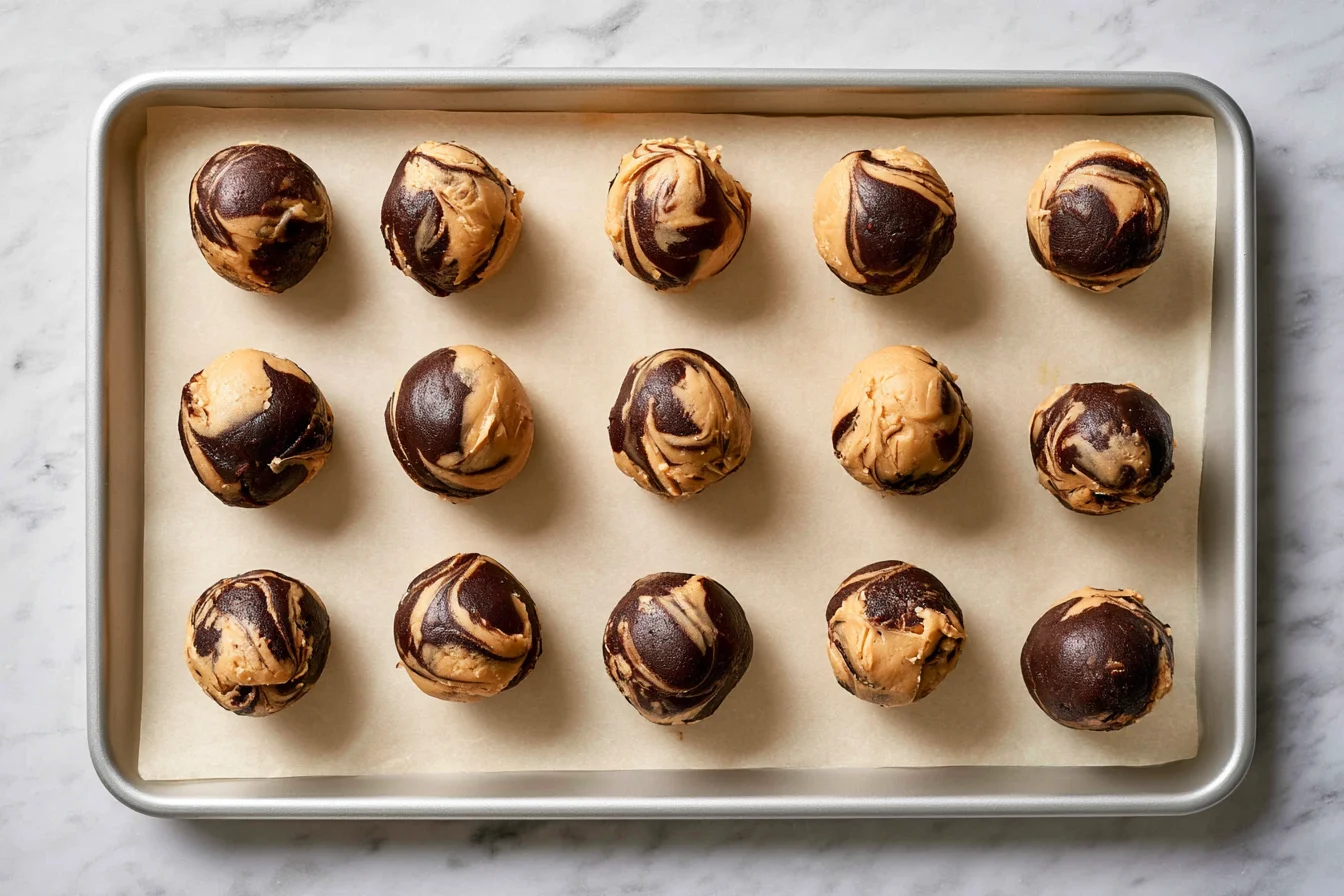
Scoop a tablespoon of each dough. Press the two pieces together and roll once between your palms into a single ball.
One roll. You should still see two distinct colours, not a blend.
5. Chill the shaped balls
Space the balls on a parchment-lined sheet about two inches apart, cover, and refrigerate for 30 minutes.
Cold dough spreads less, which keeps the bands wide instead of stretching them thin.
6. Bake
Bake at 350°F for 10 to 12 minutes.
The edges should be set and the centres should still look wet and underdone. That is the moment.
7. Rest on the sheet
Leave them on the hot sheet for 10 minutes before moving them to a rack.
They finish cooking here. Lift one too early and it folds in half.
Pulling Them Early
A brownie cookie that looks done in the oven is already overbaked on the plate.
The residual heat of the baking sheet does ten minutes of extra cooking after the oven, and that is accounted for in the ten to twelve minutes. Wait for the centre to firm up before you take the tray out and you will get a dry, cakey cookie instead of a fudgy one.
What you are looking for: a ring of set, matte edge about a centimetre wide, and a centre that still looks glossy and slightly sunken. The surface may have fine cracks. The cookie will not look finished, and should not.
What Makes the Swirl Disappear
- Rolling more than once. Every extra pass blends the colours. Roll once and put it down.
- Warm chocolate in the brownie dough. It thins that dough, which then spreads under the other one.
- Skipping the chill. Room-temperature balls spread wide and the bands stretch into faint streaks.
- Uneven portions. A tablespoon of one and two of the other reads as a brown cookie with a pale patch.
- Overbaking. Both doughs darken as they dry, and the contrast between them closes.
| Chilled 30 minutes | Straight to the oven | |
|---|---|---|
| Spread | Thick, domed centre | Wide and flat |
| Swirl | Broad, clearly separate bands | Stretched into thin streaks |
| Texture | Fudgy through the middle | Crisper, drier edges |
Ways to Change Them
- Flaky salt. A pinch on each ball before baking, which does more for a sweet cookie than any addition inside it.
- Crunchy peanut butter. Same quantity, more texture, slightly less tidy swirl.
- Peanut butter cups. One pressed into the centre of each ball, closer to chocolate peanut butter cookie cups.
- One dough only. The brownie half alone makes something like salted brownie cookies; the peanut butter half alone gives you old-fashioned chewy peanut butter cookies.
- Bar form. The same two doughs dropped and swirled in a pan become peanut butter brownie caramelitas.
Keeping Them
Store them in an airtight tin at room temperature for 4 days, with a slice of sandwich bread in the tin — the cookies take moisture from the bread and stay soft. Baked cookies freeze for 3 months, and shaped raw balls freeze just as well: bake them from frozen with two extra minutes.
One thing worth saying about the raw dough, because two doughs mean twice the temptation to taste. The FDA is blunt about it: eating raw flour, dough or batter could make you sick, and the risk is the flour as much as the eggs, with Salmonella and E. coli both linked to past outbreaks. Baking is what deals with it.
For a bigger cookie tray, these sit well next to dark chocolate peanut butter cookies, which share the flavour but not the look.
FAQ
Why did my cookies turn out all brown?
The doughs were worked together too much. Press the two pieces and roll once, then stop — a second roll blends them. Soft brownie dough does the same thing on its own, so let the melted chocolate cool before mixing it in.
Do I have to chill the dough?
You can bake without chilling, but the cookies spread wider and the swirl stretches into streaks. Thirty minutes after shaping is enough, and it is the single cheapest improvement to how they look.
Can I freeze the dough?
Yes. Freeze the shaped balls on a tray, then bag them for up to 3 months. Bake from frozen at the same temperature, adding about two minutes.
How do I know when they are done?
Set edges, glossy and slightly sunken centres. They look underbaked coming out and firm up during the ten minutes on the hot sheet. A cookie that looks finished in the oven will be dry once cool.
Peanut Butter Brownie Swirl Cookies
Ingredients
Equipment
Method
- Cream the butter, peanut butter, granulated sugar and brown sugar until light. Beat in the egg and vanilla, then fold in the flour, baking soda and salt until just combined.
- Melt the butter and chocolate chips together in 30-second bursts in the microwave, stirring between each. Set aside until no warmer than your hand.
- Whisk the sugar, eggs and vanilla, stir in the cooled chocolate, then fold in the flour, cocoa, baking powder and salt. The dough should be as stiff as the peanut butter dough; if looser, refrigerate it for 10 minutes.
- Scoop 1 tablespoon of each dough. Press the two pieces together and roll once between your palms into a single marbled ball. Do not roll twice.
- Space the balls about 2 inches apart on parchment-lined baking sheets, cover and refrigerate for 30 minutes. Heat the oven to 350°F.
- Bake for 10 to 12 minutes, until the edges are set and the centres still look glossy and underdone.
- Leave the cookies on the hot sheet for 10 minutes, then transfer to a wire rack to cool completely.
Leave a Reply