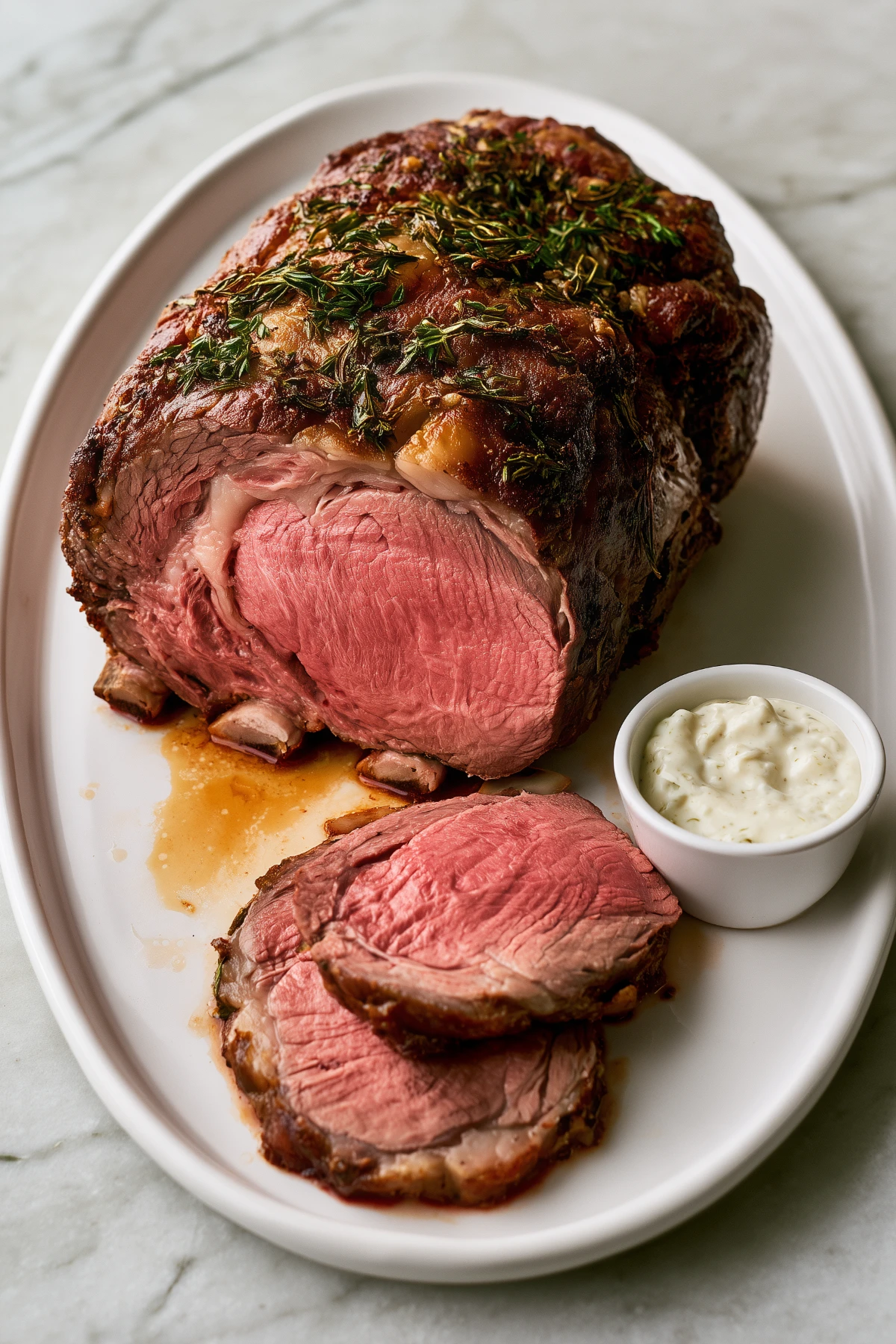
The thermometer goes into the roast before the oven door closes, and it stays there until the end. That one habit does more for a prime rib recipe than any rub, because minutes per pound are only a forecast. For a 7-pound bone-in roast, count on just under two hours in the oven and a 30-minute rest, then carve thick slices with a rosy center under a dark garlic-herb crust.
Minutes per Pound Is a Forecast
Every chart for this cut gives a different number, and the charts are not wrong. They are aiming at different temperatures. The federal roasting chart allows 23 to 25 minutes per pound at 325°F for a 4 to 6 pound bone-in rib roast, because it takes the meat to 145°F. Recipes that stop at medium-rare, after a hot 15-minute start, run closer to 13 or 14.
So the clock tells you when to start checking. The probe tells you when to stop. Pick a target from the table and take the roast out at the first number, not the second: the temperature keeps climbing 5 to 10 degrees while the meat rests.
| Doneness | Take it out at | After the rest | Minutes per pound at 325°F* |
|---|---|---|---|
| Rare | 115 to 120°F | about 120 to 130°F | 10 to 12 |
| Medium-rare | 125 to 130°F | about 130 to 140°F | 13 to 14 |
| Medium | 135 to 140°F | about 140 to 150°F | 14 to 15 |
*Counted after the first 15 minutes at 500°F. For the record, 145°F followed by a 3-minute rest is the minimum the USDA lists for beef roasts. Only the medium row reaches it, and only at its upper end. Anything pinker is a choice you make for your own table.
Ribs, Pounds and Grades: Buying the Roast
The word “prime” in the name describes the cut, a standing rib roast. It does not mean the meat carries the USDA Prime grade, so read the label. Prime is the top grade and has the most marbling, and it is generally sold to restaurants and hotels. Choice has less, yet the USDA describes Choice rib roasts as “very tender, juicy, and flavorful” and suited to dry heat. A Choice roast is the practical buy.
Two rules size it. One rib feeds two to three people, and a bone-in roast needs roughly three-quarters of a pound to a pound per guest, bones included. The table does the arithmetic.
| Guests | Ribs | Bone-in weight |
|---|---|---|
| 4 | 2 | 3 to 4 lb |
| 6 | 2 to 3 | 4½ to 6 lb |
| 8 | 3 to 4 | 6 to 8 lb |
| 10 | 4 to 5 | 7½ to 10 lb |
Ask the butcher to cut the bones off and tie them back on. The roast still cooks on its own rack of ribs, and at carving time the bones lift away as soon as you snip the string.
For a 7-Pound Roast
Three ribs, eight generous portions. Scale the salt and the rub with the weight if yours is bigger or smaller.
The roast
- 1 bone-in prime rib roast, 3 ribs, about 7 lb (3.2 kg)
- 3½ teaspoons kosher salt (Morton) or fine sea salt, about ½ teaspoon per pound. Diamond Crystal is lighter by volume: use 2 tablespoons.
- 6 garlic cloves, finely chopped
- 2 teaspoons finely chopped fresh rosemary
- 1 teaspoon fresh thyme leaves
- 2 teaspoons coarsely ground black pepper
- 3 tablespoons olive oil
Horseradish cream (optional)
- ½ cup sour cream
- 2 tablespoons prepared horseradish, drained
- 2 tablespoons mayonnaise
- 1 teaspoon apple cider vinegar, or 1 tablespoon lemon juice
- 1 tablespoon chopped chives
- ¼ teaspoon salt
- ⅛ teaspoon black pepper
The Night Before, Then Roasting Day
1. Salt it and leave it uncovered
Pat the roast dry, rub the salt over every side, bones and ends included, and set it fat side up on a rimmed tray. It goes into the refrigerator uncovered overnight, and up to 24 hours is fine. By morning the surface looks darker and feels dry to the touch.
Short on time? Salt it in the next step instead, an hour before it goes into the oven.
2. Let it sit out, then rub
Take the roast out of the refrigerator 1 to 2 hours before roasting. Stop at two: that is the limit food-safety guidance sets for perishable food at room temperature, and recipes that call for half a day on the counter ignore it.
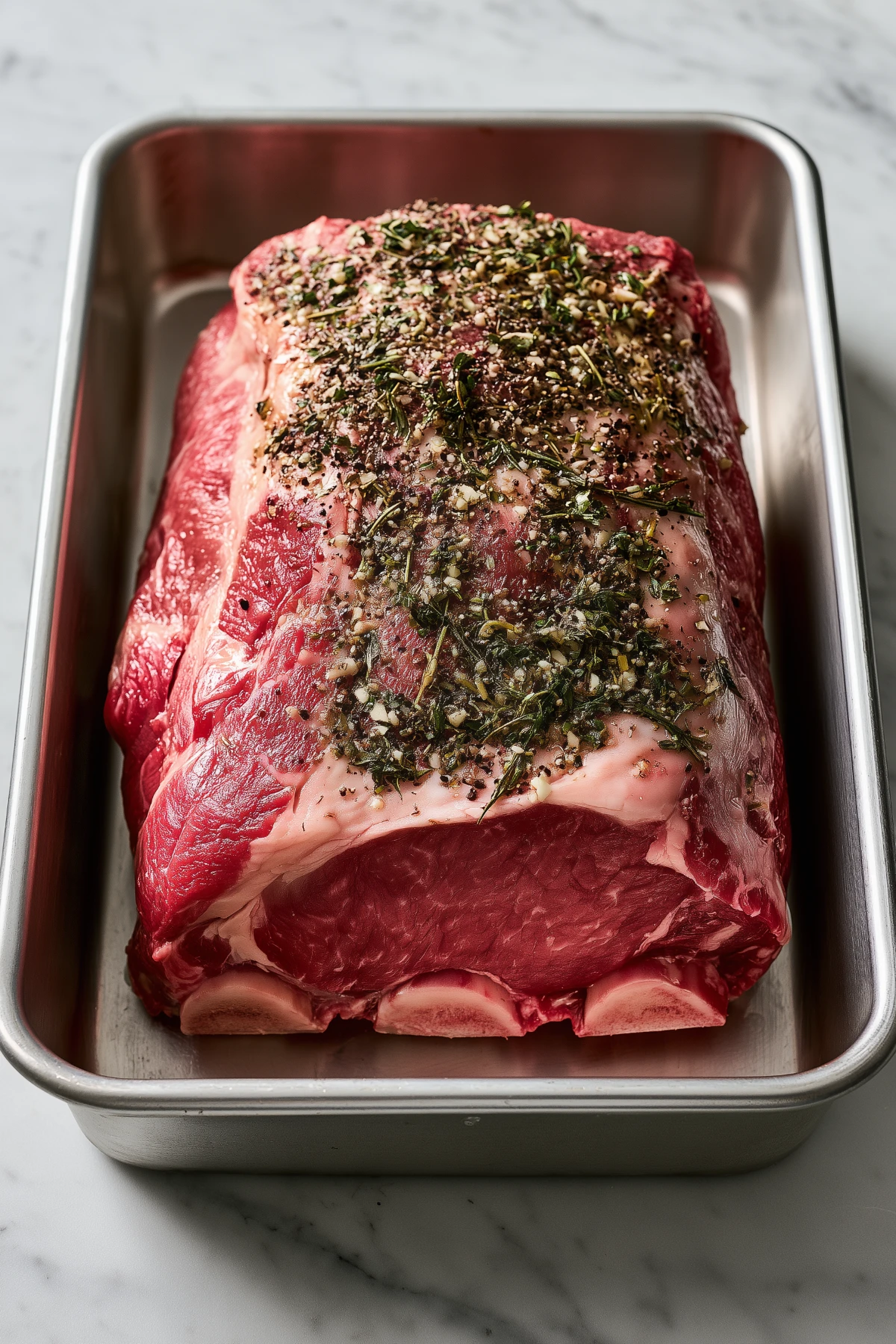
While it sits, stir the garlic, rosemary, thyme, pepper and olive oil into a loose paste and spread it over the top and sides. Heat the oven to 500°F with a rack in the lower third.
3. Fifteen minutes at 500°F
Set the roast in a roasting pan or a large cast-iron skillet, bones down and fat side up. The ribs hold the meat off the metal, so no rack is needed. Roast for 15 minutes. When you reach for the dial, the fat should be sizzling loudly and the cap should have started to brown.
4. Turn down to 325°F
Lower the oven to 325°F and leave the roast where it is. For medium-rare, a 7-pound roast needs roughly another 1 hour 30 to 1 hour 40 minutes. Begin watching the thermometer after the first hour, and take the pan out when the center reads 125 to 130°F, or whichever pull temperature you chose from the table.
5. Rest it under foil for 30 minutes
Move the roast to a board and tent it loosely with foil. Thirty minutes is not padding. The center gains its last 5 to 10 degrees during this time, so a roast carved straight from the oven is still short of its target.
The oven is free again, which is the moment for anything that needs high heat. Yorkshire puddings, for one, bake at 425°F.
6. Take off the bones and slice
Snip the string. If the butcher did not pre-cut the ribs, stand the roast up and run a long knife down along the bones, following their curve, until the rack comes away in one piece. Lay the meat cut side down and slice across the grain, about ½ inch thick.
Spoon the juices from the pan and the board over the slices, or over a bowl of garlic mashed potatoes.
7. Stir the horseradish cream
Mix the sour cream, horseradish, mayonnaise, vinegar, chives, salt and pepper in a small bowl. It can go to the table at once. If you make it first, keep it covered in the refrigerator and taste it before serving: another spoonful of horseradish makes it sharper.
Where the Probe Goes
Into the center of the thickest part, from the side or from the top, with the tip well away from the bones and from any thick seam of fat. That is the standard placement for a meat thermometer, and it matters more than usual here because the eye of a rib roast is so thick.
A leave-in probe with an alarm is the easy way. With an instant-read thermometer, check at the one-hour mark of the 325°F stage and then every 10 to 15 minutes. Do not judge by color through the oven window, because the crust is dark long before the center is ready.
Three Ways to Lose a Good Roast
- Cooking by the clock. Two roasts of the same weight can differ in shape and in how cold they were going in. Minutes per pound gets you close; only the thermometer finishes the job.
- Roasting all the way to the target. Take it out at 135°F hoping for medium-rare and the rest carries it to medium.
- A long morning on the counter. One to two hours takes the chill off. More than two breaks the rule for perishable food.
Boneless, Seared Last, or a Smaller Cut
- Boneless. Set it on a rack, since there are no ribs to stand on, and expect it to take longer per pound. The USDA chart lists 28 to 33 minutes per pound for a boneless rib roast against 23 to 25 for bone-in, both cooked to 145°F.
- Reverse sear. The order flips. Roast at 250°F until the center reads 115 to 120°F, which takes 3 to 4 hours for most roasts, rest 30 minutes under foil, then brown it at 500°F for 5 to 10 minutes. Worth knowing: the same USDA chart advises roasting meat at 325°F or higher.
- A different crust. Swap the rosemary and thyme for sage or herbes de Provence, or leave the herbs out. Several well-known versions use nothing but salt and cracked pepper.
- A smaller table. For four people, consider a 2-pound roast beef tenderloin, seared and then roasted at 425°F with rosemary, thyme and Dijon.
Day Two
Refrigerate leftovers within 2 hours of serving, wrapped tightly or in a shallow covered container, and use them within 3 to 4 days. A large piece keeps better than slices. For longer storage, wrap portions twice and freeze them; plan to use them within 2 to 3 months and thaw overnight in the refrigerator.
To reheat, lay slices in a baking dish, add a splash of beef broth, cover tightly with foil and warm in a 250 to 325°F oven for 10 to 15 minutes. The USDA figure for reheated leftovers is 165°F, which takes the slices past pink. That is the trade.
Cold slices are the better second act. Shaved thin, they are exactly what French dip sandwiches ask for: sliced roast beef on rolls with Swiss cheese and a bowl of hot beef broth for dipping.
What Shares the Plate
The roast is rich and it holds the oven for two hours, so the sides that fit are stovetop dishes or ones baked ahead.
- Creamed spinach, made in one skillet with butter, cream and a pinch of nutmeg.
- Cheesy scalloped potatoes with gruyère, cheddar and thyme. They bake at 375°F, so give them an earlier slot or a second oven.
FAQ
How long does prime rib take per pound?
At 325°F, after a 15-minute start at 500°F, allow 10 to 12 minutes per pound for rare, 13 to 14 for medium-rare and 14 to 15 for medium. Treat those as estimates and pull the roast by temperature.
How much prime rib do I need per person?
Plan on three-quarters of a pound to a pound of bone-in roast per person, or one rib for every two to three guests. With several side dishes on the table, the lower figure is enough.
Should prime rib be covered while it roasts?
No. It roasts uncovered from start to finish so the crust can form. Foil comes in only afterward, as a loose tent during the 30-minute rest.
Do I have to buy USDA Prime beef?
No. Prime is the top USDA grade and has the most marbling, but it is generally sold to restaurants and hotels. The USDA describes Choice rib roasts as very tender, juicy and flavorful, and Choice is what this recipe assumes.
Prime Rib Recipe
Ingredients
Method
- The night before, pat the roast dry and rub the salt over every side. Set it fat side up on a rimmed tray and refrigerate it uncovered overnight, up to 24 hours.
- Take the roast out of the refrigerator 1 to 2 hours before roasting. Mix the garlic, rosemary, thyme, pepper and olive oil into a paste and spread it over the top and sides. Heat the oven to 500°F with a rack in the lower third.
- Place the roast in a roasting pan or large cast-iron skillet, bones down and fat side up. Roast at 500°F for 15 minutes.
- Lower the oven to 325°F and keep roasting until a thermometer in the center of the thickest part reads 125 to 130°F for medium-rare, about 13 to 14 minutes per pound (roughly 1 hour 30 to 1 hour 40 minutes for 7 lb). Pull at 115 to 120°F for rare or 135 to 140°F for medium.
- Transfer the roast to a board, tent it loosely with foil and rest it for 30 minutes. The temperature rises another 5 to 10 degrees.
- Cut the string, slice along the bones to remove the rack, then slice the meat across the grain about 1/2 inch thick. Spoon the pan juices over the slices.
- Stir the sour cream, horseradish, mayonnaise, vinegar, chives, salt and pepper together in a small bowl. Serve at once or keep covered in the refrigerator until needed.
Leave a Reply